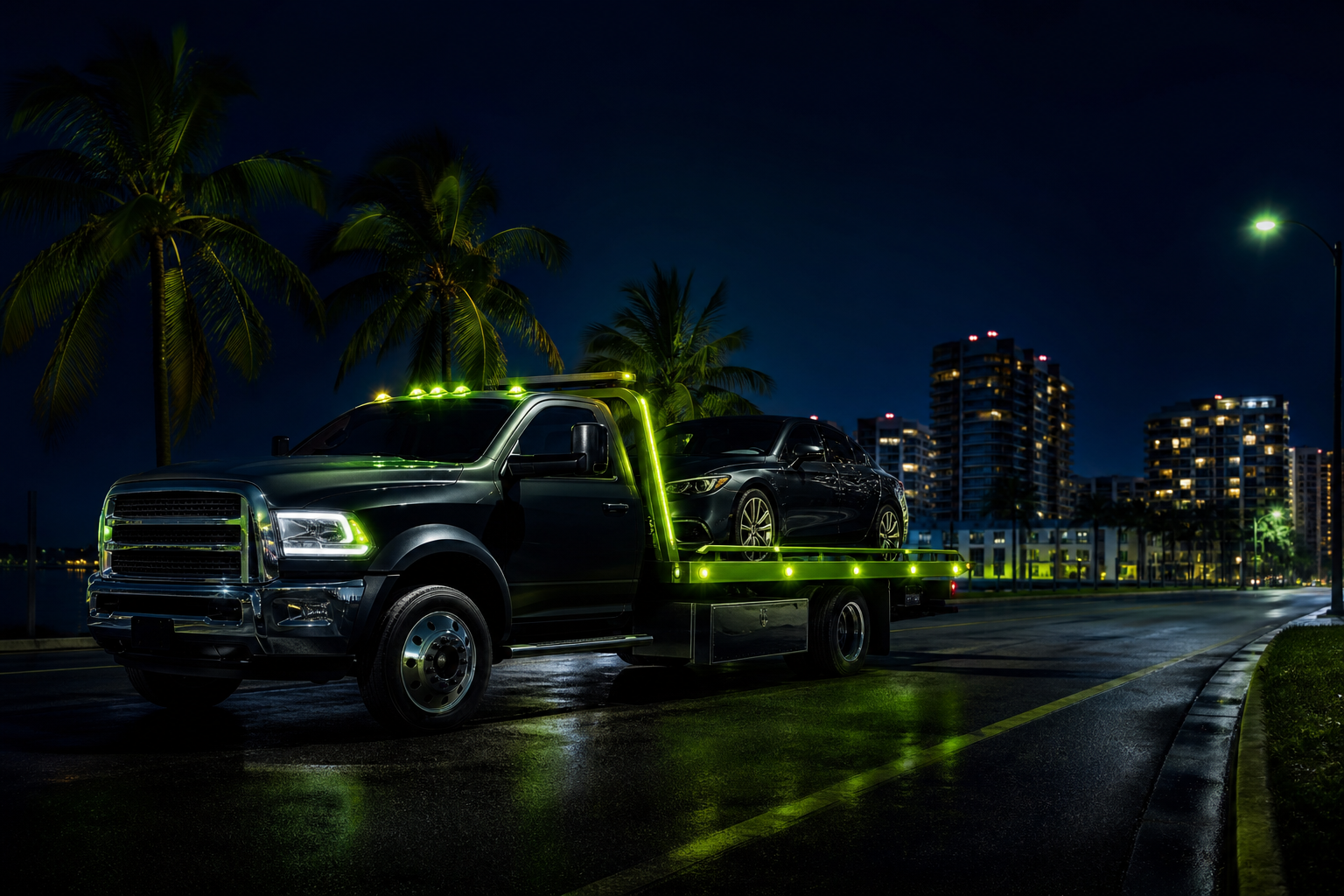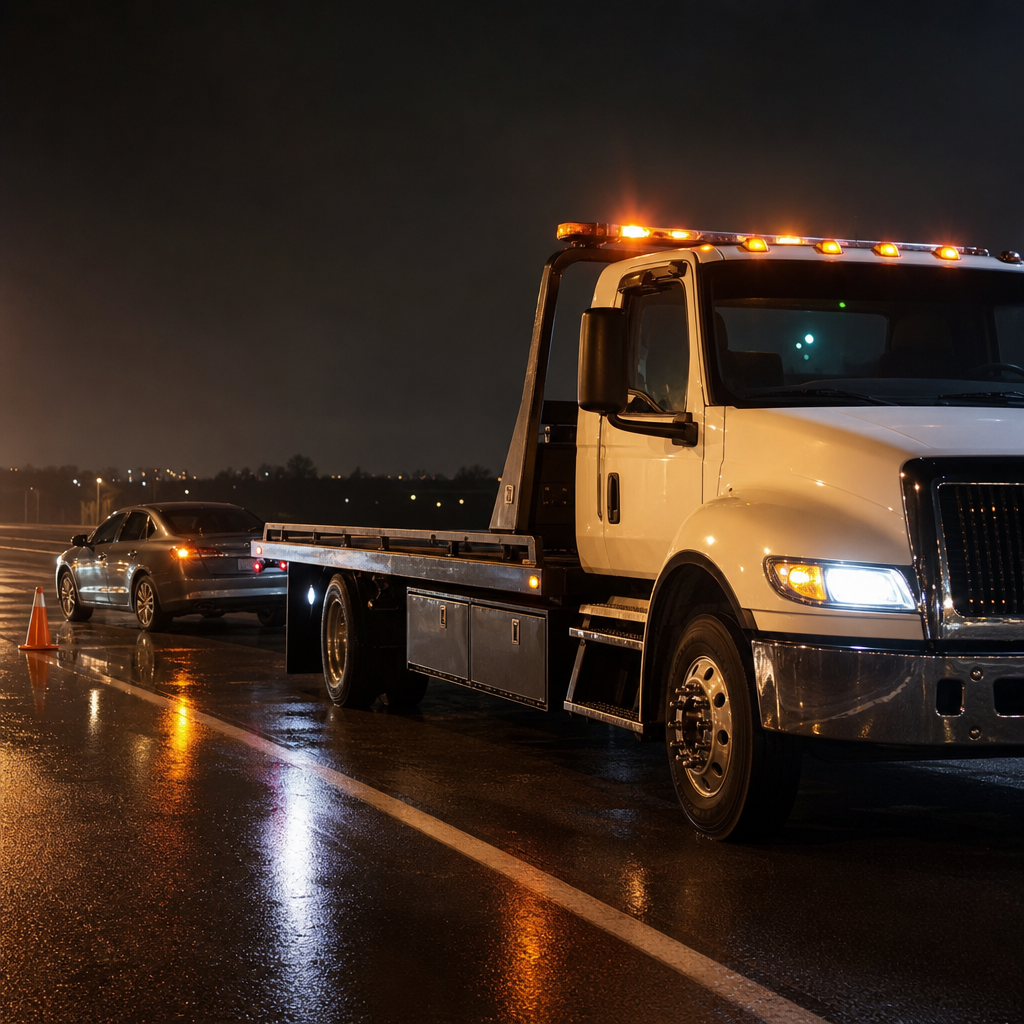
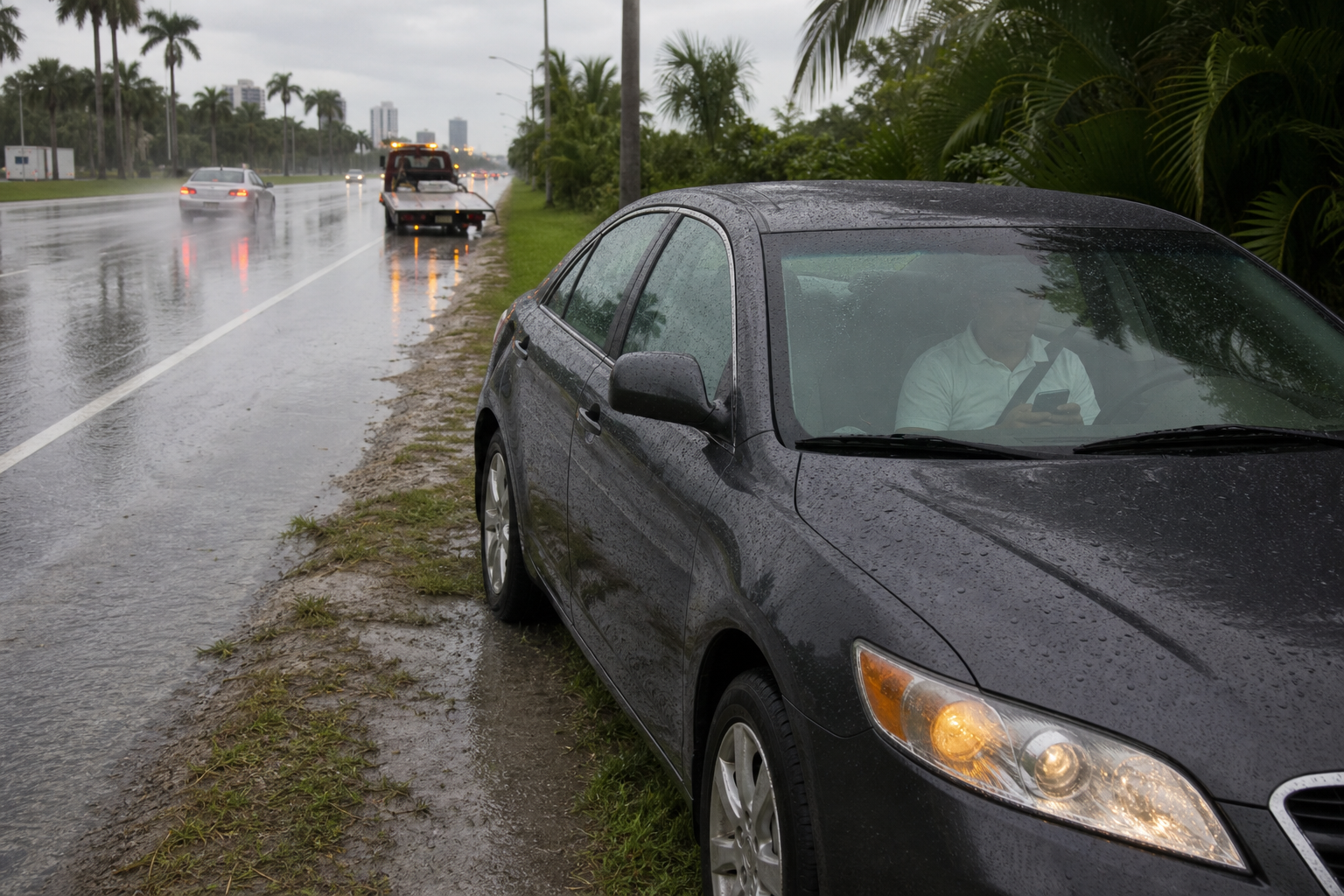
In West Palm Beach, a stall can become more dangerous when hard rain reduces visibility and hides standing water at the road edge. The nearest shoulder may not be usable, and Florida heat can make waiting inside a powerless vehicle difficult. Your first decision is therefore not simply “Can the engine restart?” It is “Which action reduces exposure to moving traffic without risking more vehicle damage?”
Before moving: match the symptom to the safest response
Use this matrix quickly. Do not spend several minutes troubleshooting while the vehicle occupies an exposed position.
| What you notice | Likely capability | Immediate choice |
|---|---|---|
| Engine stops, but the car is still rolling | Steering and braking may still work with added effort | Signal, activate hazards, and coast toward a clearly usable area outside active traffic. Avoid abrupt lane changes. |
| Engine runs, but there is severe shaking, loud knocking, grinding, or loss of power | The car may move, but continued driving could worsen the failure | Travel only far enough to escape the traffic stream, then shut the engine off and request towing. |
| Temperature warning, rising temperature gauge, steam, or a hot smell | Restarting or continuing may cause additional damage | Stop in the safest reachable place. Turn off the engine. Do not open a hot cooling system. |
| Battery warning appeared, lights dimmed, and the engine died | The charging system may no longer support the vehicle | Move out of traffic if momentum allows. A jump may not provide a lasting solution; towing is usually the safer next step if the vehicle died while running. |
| Engine cranks but does not start | The battery has some power, but the cause is uncertain | Stop repeated attempts after a few brief tries. Preserve battery power for hazards, communication, and vehicle access. |
| Clicking or no crank after the car was parked or shut off | A weak battery is possible | If the vehicle is already in a protected location and there are no heat, smoke, or fluid warnings, jump-start service may be appropriate. |
| Smoke, flames, strong fuel odor, or rapidly spreading fluid | The vehicle may be unsafe to occupy or approach | Exit away from traffic if a safe route exists, move well clear, and call 911. Do not attempt a restart. |
During the stall: stop, coast, or continue briefly?
The condition of the vehicle—not the convenience of the next destination—should control the tow-versus-drive decision.
Continue only far enough to clear traffic when:
- The engine is running smoothly enough to maintain controlled movement.
- Braking and steering respond normally.
- No temperature, oil-pressure, or other critical warning is showing.
- There is no smoke, steam, fuel odor, grinding, or significant fluid loss.
- The route into the safe area is visible and does not require crossing standing water or an uncertain soft shoulder.
“Continue” means reaching the nearest protected stopping place—not testing whether the car can complete the trip across West Palm Beach.
Stop and arrange a tow when:
- The engine overheated, stalled repeatedly, or lost power under acceleration.
- A red warning remained on, or the cause of the stall is unknown.
- Steering, braking, a tire, or the vehicle’s electrical system is impaired.
- The car restarted but runs roughly, makes a new mechanical noise, or cannot hold a steady idle.
- Rain, darkness, traffic flow, or standing water makes another breakdown especially difficult for approaching drivers to see.
A restart does not prove the car is roadworthy. If it cannot be driven predictably, request emergency towing rather than attempting a longer trip.
Once stopped: one roadside checklist
Position and visibility
- Get completely outside the travel lane when that can be done under control. Do not use a flooded, soft, sharply sloped, or poorly visible edge merely to gain a few extra feet.
- Leave the hazard lights on. At night, retain enough battery power for visibility and communication.
- Set the parking brake after stopping. Choose wheel position according to the actual curb, slope, shoulder, and direction of traffic; there is no single safe wheel angle for every location.
Occupant safety
- Choose the safer waiting location based on the surroundings. Inside the vehicle is often preferable when exiting would place occupants near moving traffic.
- If smoke, fire, fuel odor, rising water, extreme cabin heat, or another immediate threat makes the vehicle unsafe, exit from the side farther from traffic when possible and move away without crossing active lanes.
- Keep children and pets under direct control. Do not gather around the disabled vehicle or attempt repairs beside live traffic.
Quick observations for the service provider
- Note the last warning light or gauge change you saw.
- Record whether the engine cranks, clicks, restarts, or remains completely unresponsive.
- Look for fluid only from a safe position; do not crawl beneath the car or touch an unknown leak.
- Note whether the steering turns, the transmission can select neutral, and the parking brake releases. Do not test these if doing so could let the car roll.
Before help arrives: prepare the vehicle and the handoff
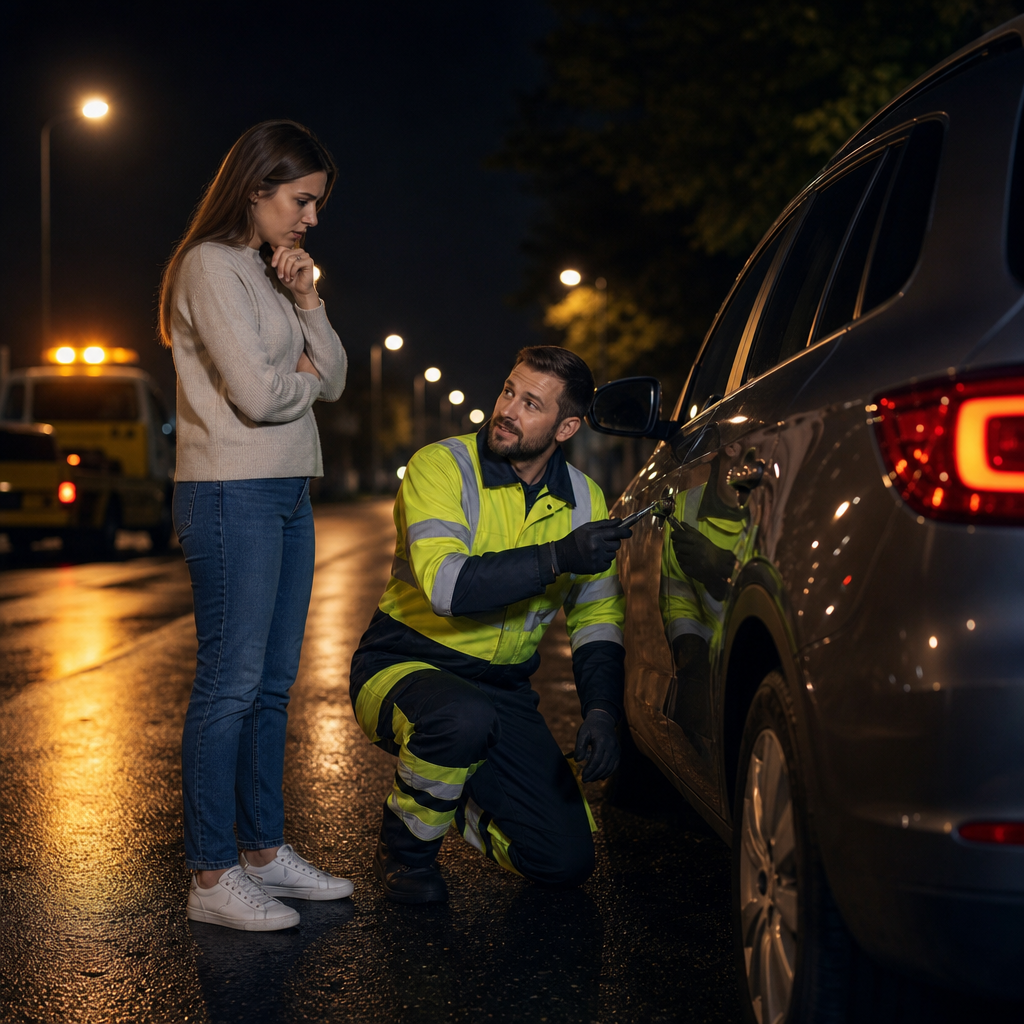
A clear service request helps determine whether the situation calls for roadside assistance, conventional towing, or a flatbed.
Give the dispatcher these details
- Your location in West Palm Beach or elsewhere in Palm Beach County, including direction of travel and a nearby visible cross street or business if known.
- Whether the vehicle is fully outside traffic, partly blocking a lane, in standing water, or in another exposed position.
- The vehicle’s year, make, model, color, and drive type if known.
- The symptom that occurred before the stall and any warning lights, smoke, steam, unusual noise, or leaking fluid.
- Whether the car rolls, steers, shifts into neutral, and has accessible keys.
- Any clearance, surface, gate, parking, or wheel-damage issue that could affect tow-truck access.
Prepare without increasing exposure
- Keep the phone available and answer calls from the service provider.
- Gather the key and essential personal items only if they are safely accessible.
- Tell the dispatcher before service if a wheel is locked, the suspension is low, the electrical system is dead, or the vehicle cannot enter neutral.
- Do not stand behind, in front of, or between the disabled car and an approaching tow truck.
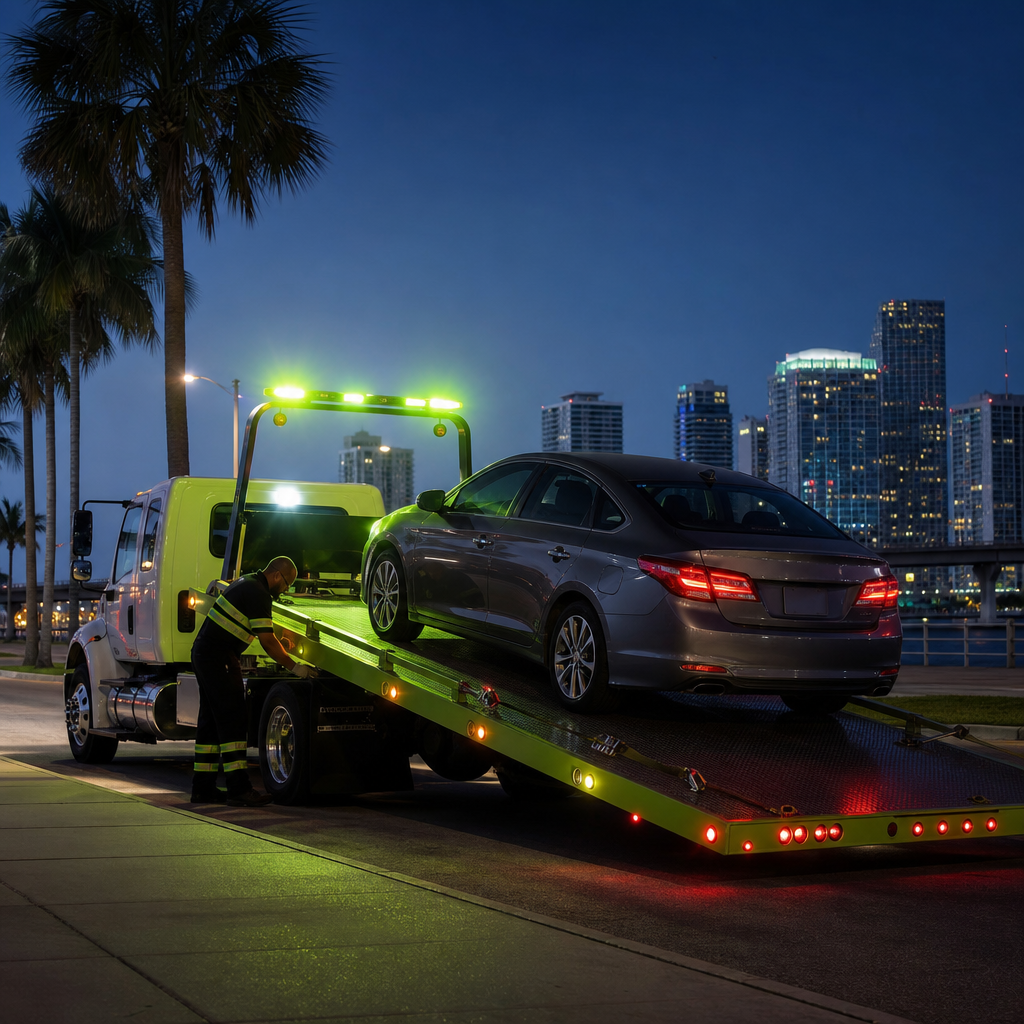
Vehicles with wheel, steering, suspension, drivetrain, or low-clearance concerns may need flatbed towing. Describe the condition rather than guessing the required equipment; the towing provider can use those details to plan the loading approach.
Common stall questions
Can a jump start fix a car that died while driving?
Not necessarily. If the engine stopped while already running, the issue may involve the charging system or another fault rather than a battery that simply discharged while parked. Even if a jump restarts it, arrange towing if the battery warning remains on, the lights dim, or the engine begins losing power again.
Should another driver push my car out of the lane?
A push can expose people to traffic and may be impossible if steering, braking, or shifting is compromised. Do not organize an improvised push in active traffic. Report the lane obstruction and let trained responders determine how the vehicle should be moved.
What if I cannot identify my exact location?
Use the phone’s map pin if available, then describe the direction you were traveling and any visible cross street, address, building name, or business sign. Tell the dispatcher what you can see rather than walking along the road to search for a marker.
Can a powerless vehicle still be loaded onto a tow truck?
Usually, but a dead electrical system, locked steering, engaged parking brake, inaccessible key, or inability to select neutral can change the loading method. Mention each condition when requesting service so appropriate towing equipment can be considered.
Choose the next step based on the car’s condition
Request roadside help when the vehicle is safely parked, shows no signs of overheating or mechanical damage, and the symptom is consistent with a battery that failed before startup. Request towing when the car stalled while moving, restarted unreliably, displays a critical warning, leaks fluid, or cannot steer, brake, or drive predictably. Call 911 first when the stalled vehicle is creating an immediate traffic hazard or anyone faces injury, fire, or smoke.
Once the immediate danger is addressed, contact 561 Towing West Palm Beach with the vehicle condition and location details. The decision is simple: if the car cannot be trusted to move and stop normally, do not use traffic as the test drive.