
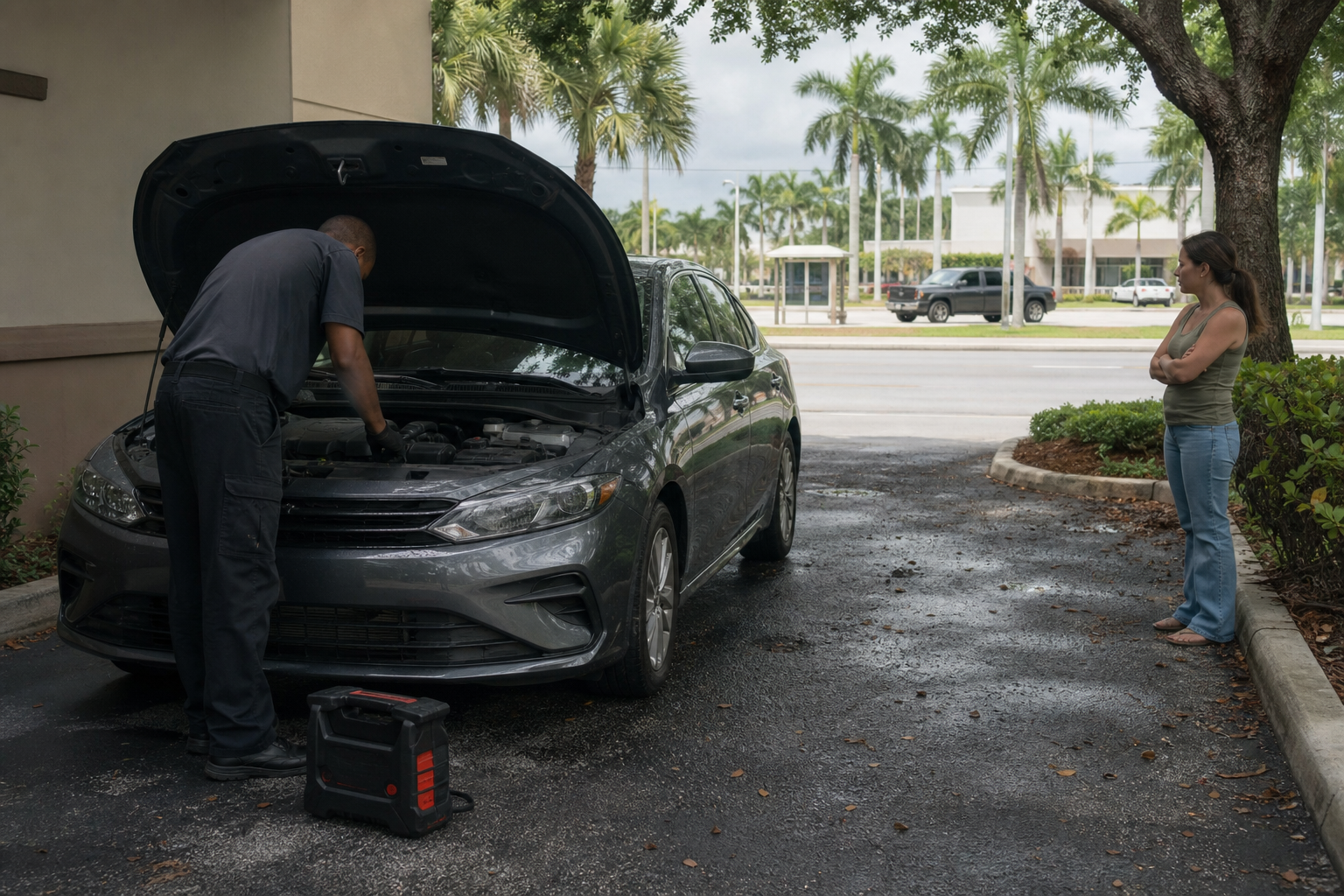
A car that will not restart in a heat-soaked West Palm Beach parking area creates two separate problems: getting the engine running and deciding if it can be trusted to stay running. Heat around the vehicle, limited shade, passing traffic, and an approaching rain shower can make repeated attempts harder on the driver and less safe. If the same vehicle has already needed one or more recent boosts, treat the next no-start as a warning—not an invitation to keep attaching jumper cables.
The realistic pattern: it starts with a boost, then fails again
Consider a common sequence. The engine does not crank in the morning, but a jump gets it going. Later, the vehicle starts normally. The next day it clicks, cranks slowly, or remains completely silent. Another boost works, yet the engine stalls after the cables are removed or the vehicle will not restart after being shut off.
A weak or discharged battery can produce this pattern, but it is not the only possibility. The vehicle may not be replenishing the battery while running, a battery connection may be loose or corroded, or an electrical draw may be draining power while the vehicle is parked. Roadside assistance can determine whether a safe boost is practical, but repeated jump starts do not identify the underlying fault.
Use these clues to separate an isolated discharge from a recurring problem:
- More consistent with a one-time discharge: an interior light or accessory was left on, the vehicle starts promptly with a proper boost, and it continues running normally afterward.
- More consistent with a larger problem: no known cause for the discharge, multiple recent boosts, dim or flickering lights, electrical warnings, slow cranking after the vehicle has been driven, or stalling soon after a jump.
- Reason to stop immediately: smoke, a burning odor, sparking away from the intended connection point, damaged cables, leaking fluid, or a battery case that appears cracked or swollen.
Immediate response: one safe decision before another attempt
Do this now: Put the vehicle in Park, apply the parking brake, switch off lights and accessories, keep passengers away from moving traffic, and inspect only from a safe position. Do not touch a damaged battery or attempt another boost if there is smoke, leaking fluid, unusual heat, a burning smell, or visible swelling.
If the vehicle is in an exposed traffic path, on unstable ground, or where standing water reaches the vehicle, prioritize personal safety and call for roadside help. Do not stand between vehicles or route jumper cables where another vehicle could strike them.
If there are no visible hazards and this appears to be the first unexplained no-start, professional jump-start service may be the appropriate first step. Tell the provider what happens when the key or start button is used: rapid clicking, one solid click, slow cranking, normal cranking without starting, or no response. Those details help avoid arriving prepared only for a simple dead battery when the vehicle may require a tow.
Do not keep boosting the vehicle when:
- It has needed multiple jump starts within a short span of normal use.
- It starts but stalls immediately or soon after the external power is removed.
- Battery or charging-system warnings remain illuminated.
- The lights weaken, gauges behave erratically, or electrical systems shut down while the engine is running.
- A correct jump attempt produces no meaningful change.
- The battery, terminals, or cables show damage that makes connection unsafe.
Repeated attempts can create heat at poor connections, drain the assisting power source, and leave the vehicle disabled in a less manageable location. A running engine is not proof that the vehicle is ready to drive across West Palm Beach or elsewhere in Palm Beach County.
Your exact location changes the roadside plan
“West Palm Beach” is not enough location detail for a driver who is in a large lot, garage, gated property, loading area, or building complex. A jump-start vehicle may be able to reach spaces that a tow truck cannot approach in the same way. Dispatch also needs to know if the disabled car is parked nose-in, blocked by nearby vehicles, or located beneath a height restriction.
Before calling, gather this practical checklist:
- Exact location: street address or map pin, property name if shown, and confirmation that the vehicle is in West Palm Beach, Palm Beach County, Florida.
- Access route: the correct entrance, gate instructions, parking level, row or section, and any turns that are easy to miss.
- Vehicle position: nose-in or nose-out, wheels straight or turned, close to a wall, and whether another vehicle blocks access.
- Clearance limits: posted garage height, low canopies, narrow ramps, or other restrictions visible at the site.
- Vehicle details: year, make, model, color, approximate size, and whether it is front-, rear-, all-, or four-wheel drive if known.
- What the vehicle does: clicks, cranks slowly, starts and stalls, shows warnings, or remains completely unresponsive.
- Jump-start history: how many recent boosts it has needed and whether it stayed running after each one.
- Loading readiness: whether the key is available, the transmission can shift to Neutral, the steering unlocks, and the parking brake releases.
Do not guess about garage clearance or drive the vehicle out solely to make towing easier. Give the dispatcher the observed restrictions so the provider can determine a workable access plan.
Choose the handoff: boost, roadside assessment, or tow
A jump start is a reasonable service request when the battery appears simply discharged, the vehicle has no damage or alarming symptoms, and there is safe access for the service provider. If the engine starts, ask what was observed during the service and avoid shutting it off until you have a sensible next destination and plan.
Request emergency towing assistance instead of another boost when the vehicle repeatedly loses electrical power, will not remain running, shows signs of an unsafe battery, or cannot be relied upon to move without stalling. Towing is also the clearer handoff when a prior proper jump made no difference.
The vehicle’s drivetrain, condition, access, and ability to roll or steer affect loading. Provide those details rather than selecting equipment by guesswork. When suitable for the vehicle and pickup conditions, flatbed towing may allow the disabled vehicle to be carried with all four wheels off the road.
Information-ready call: Have the address or map pin, entrance instructions, vehicle description, parking position, clearance restrictions, no-start symptoms, recent jump-start history, and any smoke, odor, leaking, or warning-light details ready. Then ask whether the situation should be handled as a jump-start call or a towing call.
Questions drivers ask after the second dead-battery event
How many jump starts are too many?
There is no useful universal number. One discharge with an obvious cause may be isolated. A second unexplained no-start, failure shortly after driving, or any start-and-stall pattern is enough reason to stop assuming the vehicle only needs another boost.
If the vehicle starts, is it safe to drive?
Not automatically. Watch for dimming lights, warning indicators, unstable gauges, rough electrical behavior, or stalling. If the vehicle will not remain running reliably, arrange towing rather than risk losing power while moving.
Should I request a jump start or a tow when I call?
Describe the symptoms and history first. Request a jump when the situation resembles a straightforward discharge with no damage or repeated failures. Request towing when boosts have become recurring, the engine stalls after starting, electrical warnings persist, or the battery area appears unsafe.
What if the car is inside a parking garage?
Report the garage level, entrance, posted height, ramp or turn restrictions, vehicle orientation, and whether the car can shift, steer, and roll. These details are essential for deciding how roadside assistance can reach the vehicle and how it can be moved safely.