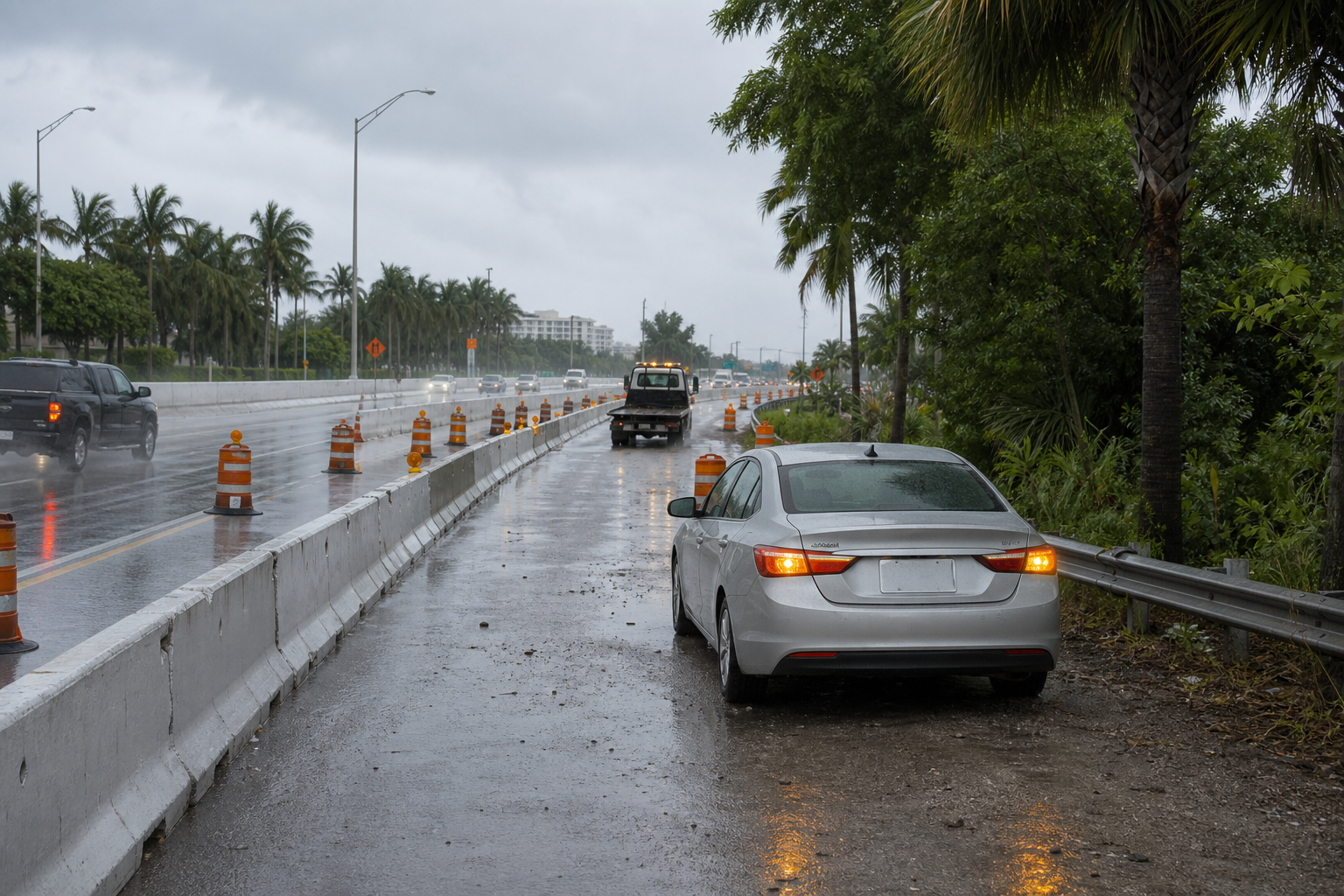
A sudden South Florida downpour can make temporary lane markings, construction barriers, and a disabled car difficult to distinguish from the surrounding glare. In a West Palm Beach work zone, the shoulder you would normally use may be blocked, narrowed, or redirected into a traffic lane. That changes the first objective: do not begin troubleshooting until you have determined whether the vehicle and its occupants can remain visible without entering moving traffic.
Risk signals: read the zone before taking another step
A roadside emergency near construction is not defined only by what failed. A flat tire in a wide, separated parking area is a different problem from the same flat tire beside a temporary traffic lane. Scan for these signals before opening a door or attempting a roadside task.
- No true shoulder: Painted tapers, barrels, barricades, equipment access points, and temporary pavement can create spaces that look usable but still carry traffic or construction vehicles.
- A narrow or shifting lane: Drivers may be concentrating on unfamiliar lane paths rather than a stopped vehicle. Curves, merges, elevation changes, and closely spaced barriers can further reduce the time they have to react.
- Rain glare or spray: Heavy rain materially reduces how soon other drivers can recognize your position. It can also hide pavement edges, holes, and uneven surfaces that make walking outside hazardous.
- A stop within the taper: The beginning or end of a lane shift is a poor waiting location because vehicles are already merging. Hazard flashers improve recognition, but they do not turn a taper into a protected shoulder.
- Traffic passing close to the driver’s side: If a door would open toward moving vehicles, remain inside unless staying creates a greater danger. Do not lean into the lane to inspect a tire or retrieve something.
- Vehicle warning signs: Smoke, flames, a strong burning odor, rising water, or damage that makes the cabin unstable requires a different response from an ordinary stall. Move away from the vehicle without crossing active lanes if a safe route exists, and contact emergency services.
Safe actions: use the playbook that matches your position
If the vehicle can still move
- Activate the hazard flashers and reduce speed smoothly. Avoid an abrupt stop inside the lane shift.
- Look for the first clearly paved area where the entire vehicle can sit outside moving traffic. Continue beyond the active construction section if that is the nearest safer option and the vehicle can reach it without being forced.
- Do not cross a line of barriers, drive through a closed work area, or enter an equipment route. Those spaces may contain workers, machinery, drop-offs, or unfinished pavement.
- Stop with the wheels directed away from traffic when the available space allows. Set the parking brake and keep occupants belted while you reassess.
If the vehicle is disabled in a live lane
Do not stand behind the car, attempt to push it through traffic, or begin a tire change. Keep the hazard flashers operating. If there is no immediate fire or similar cabin threat, staying belted inside generally avoids placing occupants on foot among moving vehicles. Call emergency services and clearly state that the vehicle is immobilized in an active lane near construction.
After the immediate traffic hazard has been reported, request emergency towing. Tell dispatch that the vehicle cannot leave the lane. That detail affects how the roadside provider evaluates access and the pickup approach.
If the vehicle is fully outside traffic
Confirm that no part of the car, including an open door, would extend into the lane. Keep occupants together and away from the traffic-facing side. In heavy rain or intense heat, the passenger compartment may be the practical waiting area if it is secure, ventilated, and safely separated from traffic. If the engine must remain off, monitor cabin temperature and move to a safer occupied location when one can be reached without walking along or across active lanes.
Once the waiting position is stable, identify the service needed:
- A vehicle that will not start but is parked completely away from traffic may be suitable for a jump start service.
- Keys locked inside a safely parked vehicle may call for car lockout assistance.
- A vehicle that cannot roll normally, has collision damage, or must be kept fully supported during transport may require flatbed towing.
Make your location useful to the dispatcher
Construction can make a map pin less precise because the actual pickup side may be separated by barriers. Provide your direction of travel, the nearest cross street or visible identifier you can confirm without walking into traffic, the side of the roadway, vehicle color and type, and whether you are before, inside, or beyond a construction taper. State whether all four wheels are on pavement and completely outside the lane.
Keep the phone available. If your location changes, update the provider rather than assuming the driver will see you. Never step into the lane or wave from beside traffic to guide a tow truck.
Avoidable mistakes that increase exposure
- Stopping at the first available gap: A gap between barriers may be an active construction entrance, not a refuge. Use only an area that is visibly open and outside both traffic and work activity.
- Trying to place warning devices in traffic: Walking backward along a narrow shoulder or entering a lane to set out triangles creates direct exposure. Hazard flashers and an accurate emergency call are safer than entering moving traffic.
- Standing between the car and a barrier: A narrow space does not guarantee protection. Avoid waiting immediately in front of, behind, or alongside the vehicle where movement could trap you.
- Opening every door: Passengers should not exit automatically. A traffic-facing door can place someone directly into a live lane.
- Attempting a roadside fix during poor visibility: Rain, spray, unstable ground, and close traffic can turn a simple task into an unsafe one. Delay hands-on work until the vehicle is in a genuinely separated location.
- Giving only a GPS pin: Temporary traffic patterns may prevent direct access from the opposite side. Direction, lane status, barriers, and the vehicle’s position are essential context.
- Downplaying a blocked lane: Tell both emergency services and the towing dispatcher immediately if any part of the vehicle remains in moving traffic.
Decision checklist: choose the next call
- Is anyone injured, or is there fire, smoke, rising water, or an immediate collision threat? Call emergency services first. Move away only by a route that does not require crossing moving lanes.
- Is the vehicle stopped in a live lane or construction taper? Keep hazards on, remain belted if the cabin is safer, report the obstruction, and request emergency towing. Do not troubleshoot in place.
- Can the vehicle move under its own power? If yes, reach the nearest clearly open area outside traffic. If no, do not push it through an active zone.
- Is the entire vehicle separated from traffic? Check the traffic-facing side, door clearance, pavement edge, and construction access before treating the location as safe.
- What service matches the problem? Choose a jump start or lockout only when the car is safely accessible. Choose towing when the vehicle cannot be made mobile at the scene or roadside work would expose people to traffic.
- Can the provider identify the correct approach? Send the location pin, direction of travel, vehicle description, construction-zone position, and whether barriers separate you from the main roadway.
Call based on the risk, not just the vehicle symptom: If your car is exposed to traffic, request emergency help and towing now. If it is fully outside the lane, tell the roadside provider exactly where it sits and select the service that fits the problem. If you cannot confidently confirm that the location is accessible and separated from traffic, treat it as a towing situation rather than attempting work beside the road.
Construction-zone roadside FAQs
Should I get out so approaching drivers can see me?
No. Standing beside the vehicle can make you more vulnerable without making the car meaningfully more visible. Use hazard flashers and stay belted when the cabin is the safer location. Exit only when a direct threat inside the vehicle outweighs the traffic risk and a safer route is available.
Can I stop between construction barrels if the shoulder is blocked?
Do not assume that space is open. Gaps may serve construction vehicles or lead onto unfinished pavement. If the car moves, continue to the nearest area that is clearly outside traffic and not separated as an active work space.
What should I tell a towing dispatcher during heavy rain?
Report reduced visibility, standing water around the vehicle if present, whether the hazard flashers work, and whether the car is in a lane, taper, shoulder, or separated paved area. Include your direction of travel and any barrier that could affect access.
Is a jump start appropriate inside a construction zone?
Only when the vehicle and service vehicle can be positioned completely outside traffic with safe working clearance. If a technician would have to stand in or beside a live lane, towing from a controlled position is the better request.