
When your vehicle will not start, has a flat tire, is stuck in an unsafe place, or cannot be driven without risking more damage, a few prepared details can make requesting help much easier. You do not need to diagnose the vehicle perfectly. The most useful thing is to clearly explain where you are, what you are driving, what happened, and where the vehicle needs to go.
For drivers in West Palm Beach, this matters especially when you are on a busy route such as I-95, near an entrance to Florida's Turnpike, or on a multilane road where locating your vehicle quickly can be difficult. Use this guide before calling for 24-hour towing, roadside assistance, or a flatbed.
1. Start With Your Exact Location
Your location is the most important detail. “West Palm Beach” alone is not enough for a driver to be found quickly, particularly on major roads, parking lots, garages, or large shopping areas.
Best ways to identify where you are
- Street address: Share the full address if you are at a home, business, hotel, parking lot, or apartment community.
- Cross streets: If there is no address visible, provide the nearest intersection.
- Highway details: If you are on I-95 or another major route, give the direction of travel, nearest exit number or exit name, and whether you are on the main roadway, shoulder, ramp, or service road.
- Visible landmarks: Mention a clearly visible business, gas station, park entrance, bridge, or major sign.
- Map pin: A phone map pin can be useful, but verify that it reflects where the vehicle is actually parked rather than where you were earlier.
If you can do so safely, look for an address on a nearby building, a street sign, a parking-space marker, or a garage level and section number. In a large lot, details such as “near the grocery store entrance” or “third row from the east entrance” can help narrow down your position.
2. Give Clear Vehicle Details
The towing provider needs to know what kind of vehicle is being moved so the appropriate equipment can be sent. A basic description is usually enough, but accurate details can prevent delays.
Vehicle checklist
- Year, make, and model
- Vehicle color
- License plate number, if convenient to provide
- Whether it is a sedan, SUV, pickup, van, or other passenger vehicle
- Whether the vehicle is in a garage, tight parking area, driveway, or another access-restricted location
Also tell the dispatcher if the vehicle has low clearance, is parked nose-in against a wall, has a wheel against a curb, or is positioned where a tow truck may have limited access. These details are not minor: they help the operator plan how to approach and load the vehicle safely.
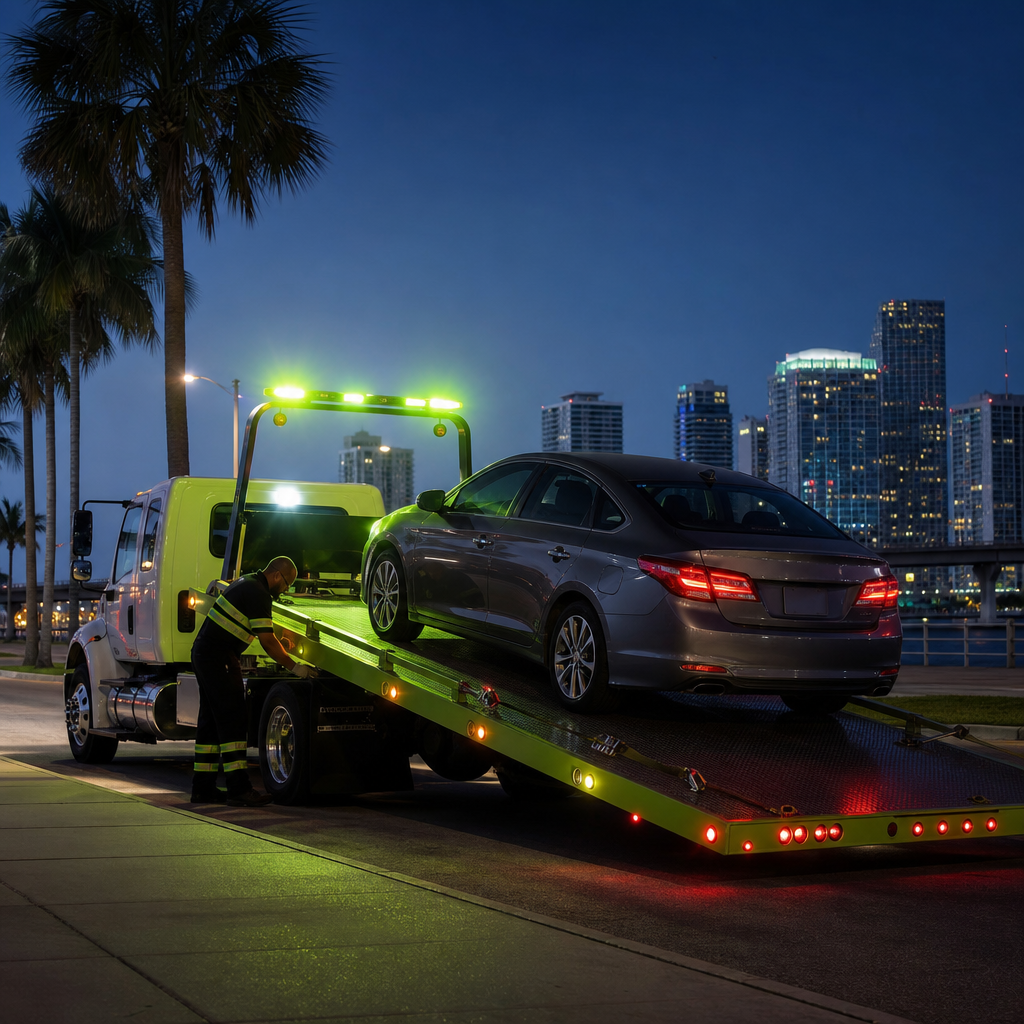
If you believe your vehicle should be transported without its drive wheels on the ground, mention that concern. You can ask about flatbed towing when you want a vehicle carried on a truck bed rather than pulled behind a tow truck.
3. Describe the Problem in Plain Language
You do not need technical terminology. Give a short, factual description of what you noticed and what the vehicle can or cannot do. This helps determine whether a tow is needed or whether a roadside service may solve the immediate issue.
Helpful problem descriptions
- “The engine will not start, but the lights come on.”
- “The battery appears dead after the vehicle sat parked.”
- “I have a flat tire and do not have a usable spare.”
- “The vehicle started, but it is overheating, so I turned it off.”
- “The vehicle is running, but it will not shift or move normally.”
- “I am locked out and the keys are inside the vehicle.”
- “The vehicle is disabled after a collision and should not be driven.”
Tell the dispatcher whether the vehicle can roll, steer, shift into neutral, and release the parking brake. If you do not know, say so. Do not force controls or repeatedly attempt to start a vehicle if doing so seems unsafe.
A no-start situation may be appropriate for jump start service if the issue appears battery-related. If keys are locked inside, car lockout service may be the more direct request. If the vehicle cannot be driven safely, ask for emergency towing.
4. Explain Whether You Are Safe Right Now
Let the dispatcher know if your vehicle is creating an immediate hazard. Examples include being partly in a travel lane, stopped on a narrow shoulder, blocking an entrance, or positioned around a blind curve. This helps communicate the urgency of the situation.
If your vehicle is in a safer location, such as a parking lot or driveway, say that as well. A clear safety description helps the tow operator know what to expect on arrival.
While waiting for assistance
- Move to a safe location away from traffic when it is safe to do so.
- Turn on hazard lights if your vehicle is stopped near moving traffic.
- Keep children and passengers away from traffic and out of unsafe areas.
- Do not stand between your vehicle and approaching traffic.
- Keep your phone charged and volume on so you can receive a callback.
- Do not attempt roadside repairs if the location or conditions make it unsafe.
If there is an immediate threat to life or safety, contact emergency services first. A towing request should not delay getting urgent help when someone is in danger.
5. Know Where the Vehicle Needs to Go
Before the tow truck arrives, decide on a destination if you can. This may be your home, a trusted repair facility, a dealership, or another location that can accept the vehicle. Have the complete address ready, including suite or service-lane information when relevant.
If you have not selected a destination, tell the dispatcher. It is better to say that you are undecided than to provide an incomplete or incorrect address. Confirm whether the destination will be accessible when the vehicle arrives, especially outside normal business hours.
For a straightforward disabled vehicle, 24-hour towing service can transport it to the destination you provide. If the vehicle is in a difficult position or cannot be safely driven, explain that during the call so the proper towing approach can be considered.
6. Have Contact and Access Details Available
Use a phone number that you can answer while waiting. If you are not staying with the vehicle, tell the dispatcher where you will be and how the tow operator can identify you. If the vehicle is in a gated community, garage, or secured lot, explain any access instructions that may affect arrival.
It is also useful to have your identification, vehicle registration, and keys available. The tow operator may need to confirm that you are authorized to release the vehicle. Keep these items with you rather than leaving them inside a locked car.
When to Call for Help Instead of Trying to Drive
Calling for towing or roadside assistance is often the safer choice when you are unsure whether your vehicle can travel without creating a hazard. Consider requesting help when:
- The vehicle will not start and a simple restart attempt has not worked.
- A warning condition, smoke, leaking fluid, overheating, or unusual noise makes driving feel unsafe.
- A tire problem leaves the vehicle unstable or you do not have a safe way to change it.
- The vehicle cannot move, steer, brake, or shift normally.
- You are locked out and cannot safely access the vehicle.
- The vehicle is disabled after a collision or other road incident.
- You are stopped somewhere that makes waiting or attempting a repair unsafe.
When in doubt, focus on safety rather than trying to get the vehicle “just a little farther.” A clear call with the right information can help get the appropriate service on the way.
Frequently Asked Questions
What is the most important information to give a towing company?
Your exact location is first. Then provide your vehicle description, what is wrong or what you observed, whether the vehicle can roll or steer, and the destination for the tow.
What should I say if I do not know my exact location?
Share the nearest cross streets, visible business or landmark, direction of travel, and any highway exit or mile-marker information you can safely see. A map pin can also help when paired with a verbal description.
Do I need to know what is mechanically wrong before I call?
No. Describe the symptoms in plain language. For example, explain that the vehicle will not start, has a flat tire, is overheating, or will not move. The goal is to communicate the situation, not to diagnose it.
Should I request a flatbed tow?
A flatbed may be appropriate when you prefer the vehicle to be carried fully on the truck bed or when the vehicle cannot be safely towed in another manner. Tell the dispatcher about the vehicle's condition and position, then ask about flatbed towing options.
What if I only need a jump start or lockout help?
Say that clearly at the beginning of the call. If the battery appears discharged, request a jump start. If keys are inaccessible inside the vehicle, request lockout assistance and provide your exact location and vehicle details.
Bottom line: A calm, accurate call begins with location, vehicle details, the problem, safety conditions, and your destination. Save this checklist on your phone so it is available before you need it.